
Iced coffee is no longer just a drink for hot summer days. Across many markets, cold coffee specialties have become a regular part of modern beverage menus — from coffee shops to hotels, restaurants and quick-service concepts. Today’s guests expect more choice, new flavor profiles and beverages that not only taste great, but also look appealing.
Cold coffee specialties continue to gain relevance: according to a recent European industry study, the share of professionals who see high year-round demand for cold coffee in their market rose from 26 to 44 percent within one year*. For hospitality operators, this development opens up new opportunities. Iced coffee can serve as a seasonal impulse, a premium take-away item or an attractive addition to the beverage menu. Combined with milk, plant-based alternatives, syrups or seasonal flavors, it creates beverages that appeal to younger target groups and generate new purchase incentives.
The operational challenge behind iced coffee
But this is where the operational challenge begins. Iced coffee sounds simple: coffee, ice, glass, done. In professional operations, however, preparation is more demanding. When hot coffee is poured directly over ice, the ice cubes melt quickly. The drink can become diluted, lose aroma and taste less expressive. What is intended as a refreshing coffee specialty can quickly appear thin or less premium.
This is why some concepts rely on manual cooling methods. In the barista scene, for example, chilled metal balls are sometimes used to cool freshly brewed coffee quickly. Other businesses brew coffee in advance and cool it in the refrigerator. Others work with cold brew or concentrate. These approaches can work, but in daily operations they also have limitations: additional preparation steps, more time, space requirements, hygiene considerations and inconsistent results.
Especially in high-traffic environments, the key question is: how can cold coffee specialties be offered efficiently, reliably and with consistent quality? For guests, it is not the method that matters, but the result in the cup: full flavor, an attractive appearance and a beverage that still delivers after a few minutes. For operators, preparation must be easy to integrate into existing workflows.
Freshly brewed, actively cooled

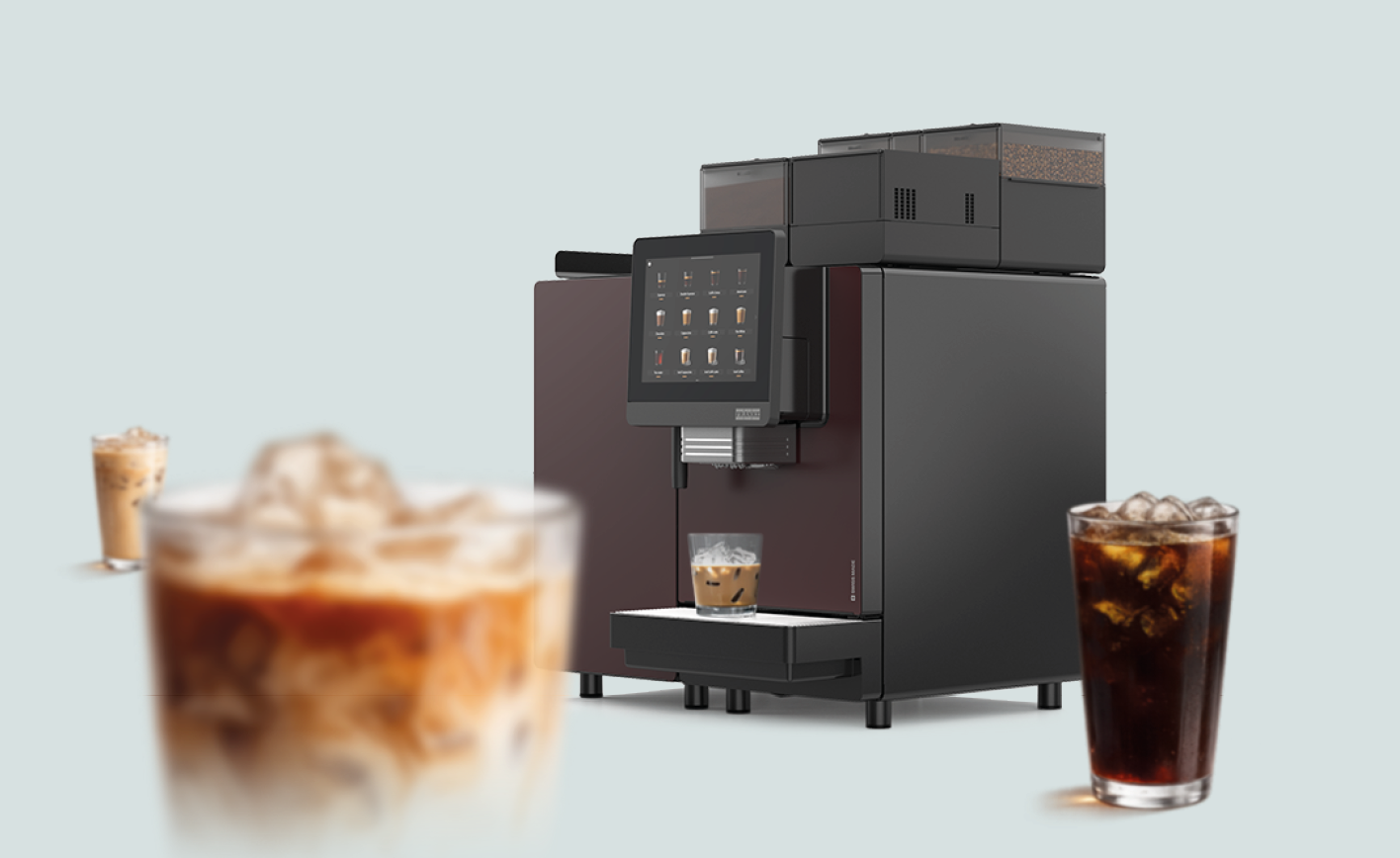
With ActiveChill, Franke adds a dedicated iced coffee solution to the New A Line, actively cooling freshly brewed coffee directly before dispensing. The coffee is extracted at the desired brewing temperature and then reduced from around 88–92 °C to a controlled in-cup temperature of 35–40 °C.
As a result, the coffee remains freshly brewed but reaches the glass or cup already significantly cooler. The ice cubes melt more slowly, helping to reduce dilution while better preserving aroma and flavor.
Another advantage of ActiveChill lies in its combination with iQFlow™, which is standard in the New A Line. This technology supports consistent extraction and therefore consistently high coffee quality — cup after cup.
For operators, this means greater reliability in daily business: premium iced coffee can be prepared repeatably, independent of individual employees or manual cooling processes. At the same time, workflows are simplified because cooling takes place automatically during dispensing and no separate external cooling device is required.
From trend beverage to scalable offer
This helps turn iced coffee from a trend beverage into a scalable offer. Hotels, restaurants, cafés and quick-service concepts can benefit from beverages that can be served quickly, attractively and consistently.
What matters most is not the technology itself, but its value in daily operations. When iced coffee can be prepared easily, repeated reliably and presented attractively, it becomes more than a seasonal extra. It becomes a versatile element of modern HoReCa concepts — with full flavor, less dilution and an appearance that appeals to guests.

Learn more: ActiveChill
*Source for statements on market development and business potential: Allegra Project Café Europe 2026.